


Are you considering taking up stand-up paddleboarding (SUP) as a hobby? It’s a great way to spend some time out or the ocean or lake, getting you as close to the water as possible. SUP suits ocean-going activities like surfing and freshwater activities like paddling across the lake or down the river.
Spending a few hours on a SUP is a great workout and a fantastic way to tone your body and develop strength. Best of all, you get out into the fresh air, experiencing the wonderment of nature in full effect.
SUPs are gaining popularity, and the chances are you see them at any water venue, inland, or at the beach. These boards come in several designs to suit various activities, and there’s a SUP to suit whatever you want to do out on the water.
This brief guide on how to stand up paddleboard will help you hit the water like an expert.
Contents
What are the Types of SUPs?
You get so many different SUP designs. They come in all sorts of shapes and sizes, offering you a design-specific SUP experience for any watersports activity.
Surf SUPs
The first SUPs featured an EPS epoxy construction, with a glassed foam core and a wooden stringer running the length of the center of the board.
These SUPs are more common in surfing applications, with designs appearing like large surfboards. They come with a rocker in the nose and tail of the board and deeper rails that hug the face of the wave.
While these surf SUPs were popular, they are heavy and long, with boards ranging from 9-feet to 14-feet in length. They aren’t as easy to transport as a surfboard given their increased size, but you can fit them to roof racks the same way you would a surfboard.
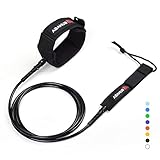
- 5 Sizes for Perfect Fit: It's suggested to choose a surfboard leash equal in length to or slightly longer than your board. Our straight surf leashes are available in 8 colors and 5 sizes: 6/7/8/9/10 feet, thus suitable for skimbords, shortboards, fishboards, longboards, funboards, SUP and paddleboards.
- Durable and No-Tangle: This surfboard leash uses a 7mm TPU cord for optimum strength and durability. The featured double anti-corrosive steel swivels can keep the leash spinning smoothly to avoid getting tangled. It's an all-round leash, designed for small to medium waves.
- Comfortable and Anti-Slip: Soft neoprene 2.4" ankle cuff provides extra comfort to wear and prevents chafing and blistering. The double wrap-around hook and loop cuff is adjustable to make sure the cuff stay tight on your ankle and adds extra strength and security to your connection.
- Safe and Protective: The paddded ankle cuff has a quick release pull tab so that you can detach yourself from the board with ease. There’s a nylon triple-wrap rail saver that can protect your board edge yet add no extra drag. The hidden key pocket gives you extra space to store keys.
- Why Shop ABAHUB: This surfboard leash is built with premium materials at an affordable price. We’ve been making surfing accessories for over 10 years, and we stand by the quality of our products.
Inflatable SUPs
In 2014, manufacturers started releasing inflatable SUPs into the market. These boards changed the game, allowing for lightweight, compact transport to your venue. These boards feature a hollow design with supporting structures that create a firm board that won’t bend when you step onto it.
You inflate the board using a hand or electric pump that connects to your car’s electrical system.
Most SUPs range in the 9-foot to 14-foot length, and they have widths of between 28-inches to 32-inches and thicknesses varying between three to seven inches.

- 3 YEAR MANUFACTURERS WARRANTY
- Roc’s Paddle Boards are now made with the highest-grade material that is 50% stronger than competitors boards. Find out why Roc is the top-rated paddle board sold on Amazon and around the world.
- With an industry leading 350lbs weight limit. You can see why Roc is committed to manufacturing the safest most reliable paddle board on the market.
- Our extra wide design creates an incredible all-around board for all skill levels. Making it the perfect board for all.
- All boards come complete with premium accessories that are superior to other board packs
Choosing Your Model
The type of SUP you select depends on the kind of watersports activities you want to do with the board. Beginners will do better with wider, thicker boards as they float better and offer superior stability on the water.
Freshwater SUPs have a design for casual use on calm waters. Surf sups are like big surfboards, featuring a surfboard-shaped design and single or thruster fin arrangements. They typically have a thinner profile than all-around inflatables, and they have other design features like single or double concaves in the hull.
Typically, surf SUPs fetch a higher price tag than inflatables, with prices being up to four times to cost of the all-round SUP models.

SUP Equipment
After selecting your board, you’re going to need to kit it out with the right equipment. Let’s look at choosing the right leash, paddle, and personal flotation device (PFD) for your SUP experience.
SUP Leashes
The leash connects you to your board. It’s not really necessary to use a leash if you are out on still water, like a lake, because there is little chance of the board getting away from you. However, if you’re out on the ocean or a river and come off the board, the waves or current will force the board to the shore, leaving you stranded out in the waves or the river.
The leash connects to the top of your calf muscle using a Velcro strap and a rubber or plastic line connecting to the board’s tail. If you fall in the waves, the board stays with you instead of traveling to the shore.
You’ll want to choose a SUP leash that’s around the same length as the board or a foot longer. Don’t use a surfboard leash as it will drag in the water, causing you to “tombstone” the board as the waves toss you around underwater.

- 10 ft for Most Fit: It's suggested to choose a paddleboard leash equal in length to or slightly longer than your board. Our coiled SUP leashes are available in 8 colors and in carefully chosen 10 feet in length, thus suitable for most longboard surfboards, iSUP and paddleboards.
- Durable and Tangle Free: This surfboard leash uses a 7mm TPU cord for optimum strength and durability. The featured double anti-corrosive steel swivels can keep the leash spinning smoothly to avoid getting tangled. It's an all-round leash, designed for small to medium waves.
- Comfortable and Anti-Slip: Soft neoprene 2.4" ankle cuff provides extra comfort to wear and prevents chafing and blistering. The double wrap-around hook and loop cuff is adjustable to make sure the cuff stay tight on your ankle and adds extra strength and security to your connection.
- Safe and Protective: The paddded ankle cuff has a quick release pull tab so that you can detach yourself from the board with ease. There’s a nylon triple-wrap rail saver that can protect your board edge yet add no extra drag. The hidden key pocket gives you extra space to store keys.
- Why Shop ABAHUB: This surfboard leash is built with premium materials at an affordable price. We’ve been making surfing accessories for over 10 years, and we stand by the quality of our products, so we are glad to offer a 1-year manufacturer’s warranty at no additional cost.
SUP PFD
If you’re new to paddleboarding and not a strong swimmer, you’re going to want to get yourself and SUP PFD. Your PFD should have certification from the US Coast Guard, stating that it meets the organization’s safety criteria.
PFDs come in a range of styles. We like the models that fit your waist like a moon bag, allowing the free movement of your arms. However, they are expensive, and going with a more affordable vest-type PFD might be the better choice if you’re running on a budget.

- U.S. COAST GUARD APPROVED: This USCG-approved Inflatable Life Jacket inflates automatically upon water immersion or manually pulling the inflation handle. Includes a back-up oral inflation tube. Approved for users 16 years or older, and over 80 lbs. Fits 30”-52” chest
- HIGHLY BUOYANT: Provides 22.5 pounds of buoyancy when fully inflated, keeping you safe and afloat. Its buoyant material offers the necessary support to keep your head above water, providing peace of mind when boating, fishing, paddling
- MANUAL INFLATION OPTION: Easily converts to MANUAL ONLY inflation mode when paddling, fly-fishing, or other activities where there is good chance you may get wet or end up in the water. Simply pull the inflation handle, providing buoyancy to keep you safely floating. Manual conversion cap included
- COMFORTABLE FIT: This inflatable PFD incorporates an adjustable body belt, front buckle closure, and a comfortable neoprene neckline, ensuring a secure and personalized fit
- REARMING KIT: Inflatable life jackets can be reused after each inflation. Always read your Owner’s Manual for the proper way to initially arm your life jacket, and how to re-arm it after it has been inflated. Use Onyx Rearming Kit #1352 for this product. It is recommended to purchase an extra rearming kit to try out your inflatable life jacket and become familiar with its operation
Paddles
The board is only one-half of the SUP. The other half is your paddle. Choosing the right paddle for your SUP is critical to ensuring you get the best performance from the board on the water. Paddles are available in various materials, from cheap plastic to pricey carbon fiber.
The paddle comes with a single blade, and the top of the paddle features a “T” and finger grips, allowing you to grab it in the overhand position to drive the paddle into the water. Paddles are available in different lengths, and you’ll want to choose one that’s around six to ten inches taller than you.

- PERFECT FOR BEGINNERS: With a light weight blade and concave grooves design, this paddle ensures a powerful and stable stroke, making it an ideal choice for beginners,casual paddlers and rental shops.(When the whole paddle is assembled, it can float in salt or fresh water)
- ADJUSTABLE FOR ALL USES: This paddle can be easily adjusted from 68’’ to 84’’, making it suitable for a variety of uses. Whether you're SUP surfing, flatwater paddling, or racing, this paddle can be adjusted to fit your needs.Our recommended paddle length is your height plus 6-8” for SUP surfing, plus 8-10” for flatwater and plus 10-12” for SUP racing. *Important: The screws on the clamps need to be checked and tightened if needed before using.
- DURABLE DESIGN: Made with aircraft grade aluminum alloy and reinforced with tough fiberglass, this stand up paddle is built to last. The anti-twist clamp and locking pin system prevents loosening in the water, ensuring maximum durability.
- TRAVEL-FRIENDLY: When broken down into 3 pieces, this SUP paddle is 35” in length and 7.2” in width,making it easy to carry and travel with. It's the perfect option for both local and international excursions.
- SHOP WITH CONFIDENCE: With over 10 years of experience manufacturing paddles, we stand by our products.
Sizing Your SUP Paddle
Sizing your SUP paddle requires a customized approach to assessing the right length for you. The defining factors surrounding your paddle choice are the following.
- Your height.
- The length of your arms.
- The length of the board.
- The application of the paddle (surf, cruising, etc.).
Basic SUP Paddling Techniques
After selecting your SUP and paddle, it’s time to head out onto the water for some practice. We recommend starting on calm waters to get a feel for the dynamics of the board before taking it into the ocean.
Standing on Your SUP
Here’s the optimal technique for standing on the board.
The Beginner Method
Launch the board and wade out into waist-deep water to prevent the fins from hitting bottom when you mount it. Place the paddle on the opposite side of the board to the side you’re mounting, and make sure you have a firm grip on it.
Place your hands on the rails on either side and pull your body onto the board. Practice doing a pushup, pulling your knees up to your chest as you rise so that you land in a kneeling position on the deck. With your hands gripping the rails, move your strong foot to the front position.
If you’re “goofy foot,” your left foot will lead, and if you have a “natural” stance, your right foot will take the lead. We recommend figuring out your stance before taking your board into the water.
After landing your front foot, shift your rear foot sideways while holding the rails and raise your hips and upper body to the standing position while releasing the rails.
Take a second to get your balance before reaching down for the paddle.
After you master this beginner method, you can move on to the advanced technique of “popping up.”
The Advanced Method – Popping Up
Popping up involves you lying flat on the board in the pushup position. You’ll push up with your upper body, launching your chest into the air while lifting your knees and placing your feet in the standing position in one smooth motion.
It’s a good idea to practice this on the beach until you’re confident you have it right. Learning the art of “popping up” takes some practice, but it’s essential if you’re planning on using the SUP in the surf. When the wave breaks, you don’t have the time to use the kneeling method.
Falling in the Water
Eventually, you’re going to fall off the board. Even if you’re out on calm water, you’re eventually going to make a mistake that lands you in the drink. Learning to fall in clam water is easy; you just fall to the side, and there’s not much to think about.
However, if you’re surfing in the ocean, it’s a different story. You’re going to need to learn to fall to the side, as far away from the board as possible. Don’t worry about the board getting away from you; the leash will keep it within reach when you get back to the surface.
The last thing you want to do is fall on the board or close to it. Surf SUPs can weigh up to 40-lbs, and if it hits you on the head in the churn, it could knock you unconscious.
The fins on the board also present a risk, and there are plenty of horror stories of surfers ending up with deep cuts on their body, neck, or face after coming in contact with the fins underwater.
Learning SUP Strokes
Mastering the SUP means that you will need to learn how to paddle effectively. Let’s unpack the three types of paddling strokes you need to get you moving.
The Forward Stroke
Grab the T on the top of the paddle with your dominant hand and place your other hand about two to three feet down the shaft of the paddle.
Reach the paddle blade out two or three feet in front of you and drive the blade into the water.
As you pull, focus on maintaining your balance and ensure you have a tight core.
As the blade enters the water, push down on the T while pulling your bottom hand towards the rear of the board as far as you can without losing your balance.
As you drive through the movement, keep your arms straight and use your upper body to provide the momentum while twisting your hips slightly to accommodate the change in balance.
The Reverse Stroke
The reverse stroke or drag will help you slow the board.
Keep your dominant hand on top, and reach back with the paddle, reversing the motion of the forward paddle.
If you’re out on the ocean and riding waves, you might find that the board moves too far away from the power zone of the wave.
To keep yourself in the power zone, drag the paddle behind you, using the blade to control the board’s direction on the wave face.
The Sweep Stroke
The sweep stroke helps you turn the board while moving or standing.
If you paddle on the left side, rotate your shoulders, so the left shoulder moves forward.
Reach forward and drive the blade into the water, sweeping it away from the side of the board in an arching motion from the nose to the tail.
While sweeping, rotate your hips.
In Closing – Top SUP Tips
Check out these tips to ensure you get the best experience out on the water with your SUP.
- Practice mounting the board and popping up on dry land before getting in the water.
- Don’t hold the paddle like a broomstick; keep one hand on the T and the other about two to three feet down the shaft, with hands shoulder-width apart.
- Keep your feet parallel and about shoulder-width apart to ensure you have the balance you need when paddling.
- If you’re out in the waves, you can use the surf stance but stand in the forward position with your feet side-by-side if you’re on flat water.
- Use your back and hips when paddling, or you’ll end up burning out your arms.
- Dip the entire face of the blade into the water.
- For your first experience, choose a flat body of water, like a lake, to practice. You can even practice in a swimming pool.
- Choose a day to SUP where there is little wind if there is wind, paddle away from it, not into it.
- Take a friend with you or tell someone where you’re going and when you’ll be back.
- Your first session should last around an hour before you start feeling tired, but you’ll get stronger every session.
- Always wear a PFD for safety.
- Practice, practice, practice!
